Automatic copy trading that runs without you.

Autopilot is our members-only vault platform. You deposit USDC into a strategy vault, an automated system trades it around the clock, and you can withdraw whenever you want. Your shares stay in your own wallet: we can trade the capital, we can never take it.

New to crypto? Watch the beginner tutorial: from a bank account to money working inside a vault, every step in plain English.

4 live strategy vaults · Self-custody: shares in your wallet · No lock-in: withdraw any time

↓ See the strategies, their backtests and their drawdowns

Step 1
Copy the trades by hand

Every membership includes the live trade signals: each position I open and close, as it happens. 185 closed trades are already public, going back to 2024. You place them yourself, in your own account, at your own size.

See the signal record →
Step 2 · this page
Or let a vault do it for you

When placing them by hand stops being practical, deposit into an Autopilot vault instead and an automated system trades around the clock. Different strategies from the signals above, and a separate fee on top of membership. Most members do one, some do both.

How copy trading on Hyperliquid actually works


1
You join Premium

Autopilot is a members-only product. An active membership is what unlocks the ability to deposit.

2
You connect your own wallet

MetaMask, Rabby, or any wallet you already control, ideally backed by a hardware key. No account with us holds your money.

3
You deposit USDC into a vault

The in-app rail walks your USDC from Arbitrum through Hyperliquid into the vault. In return the vault mints you shares, which land in your wallet.

4
The strategy trades the pooled capital

An automated bot trades the vault's balance on Hyperliquid to a fixed rule set. No discretion, no overrides, no 3am decisions.

5
Your share price moves with the strategy

Profits and losses land in the share price of the tokens you hold. You watch it in the member dashboard.

6
You withdraw whenever you like

Small withdrawals are paid instantly from the vault's liquid buffer. Larger ones are queued and settled once positions are reduced, typically in about 15 minutes.

What this is

A smart contract that pools member capital, lets an automated strategy trade it, and can only ever pay the money back out to the people who deposited it. The trading key can place orders and nothing else: it cannot withdraw.

What this is not

Not a fund and not a managed account. Nobody manages money on your behalf and nobody guarantees a return. The decision to deposit, and how much, is yours alone.

The copy trading strategies, with their drawdowns


Every figure below is a backtest, and every backtest return is printed next to the worst drawdown that produced it. Backtests are not a promise: they are the actual historical behaviour of the exact rule set the vault runs.

Funding Momentum

Market neutral At capacity · 100% full · $500k cap

Shorts the altcoins the market is paying most to bet against.

  • On Hyperliquid, whoever holds the crowded side of a bet pays an hourly funding fee. On small altcoins that fee sometimes reaches one to two percent an hour just to stay short.
  • The vault reads that fee as a signal rather than as income: it shorts the most deeply negative altcoins, up to 28 at a time, and keeps each short for days after the fee has normalised.
  • A long Ethereum position runs alongside the basket and is resized every hour, so the direction of the crypto market itself is largely taken back out of the result.
155.1%
backtested return, annualised
-15.3%
worst drawdown in that test

Tested over 2026-01-01 to 2026-08-26, leverage 1x.

The newest and least proven vault here. The hedge removes market direction over time rather than in every single hour, the test window covers only about eight months of a falling altcoin market, and the vault pays funding rather than collecting it. Treat the headline return as unproven and only commit money you can afford to lose.

Oil Convergence

Market neutral Open · $1M cap

Trades the price gap between the world's two oil benchmarks.

  • WTI and Brent crude normally track each other closely. Every so often they drift unusually far apart.
  • When they do, the vault buys the cheap one and sells the rich one, in equal dollar amounts.
  • It holds until the gap closes, then exits. One pair at a time, re-checked daily.
23.4%
backtested return, annualised
-44.8%
worst drawdown in that test

Tested over 2012-06-01 to 2026-09-02, leverage 2x.

Dollar-neutral, so it does not need oil to go up or down - but a gap can widen a long way before it closes, and the backtest's worst stretch was a 52.9% drawdown.

Stock Funding Arbitrage

Market neutral Nearly full · 96% full · $300k cap

Collects the funding spread between stock perpetuals.

  • Stock perpetuals on Hyperliquid charge a funding rate to whoever is on the crowded side of the trade.
  • The vault shorts the perp that is expensive to hold and goes long a hedge against it, so the stock's own price movement largely cancels out.
  • What is left is the funding difference between the two legs. The book is rotated daily as the spreads move.
38.3%
backtested return, annualised
-36.9%
worst drawdown in that test

Tested over 2025-11-28 to 2026-08-01, leverage 2.25x.

Market-neutral by construction, but the two legs are not identical: they can move apart. Each leg is margined separately and the strategy stops out of losers rather than holding them.

Bitcoin Trend Following

Directional, leveraged Open · $10M cap

One mechanical moving-average rule, long and short, with leverage.

  • When Bitcoin's 2-day average price crosses above its 116-day average, the vault goes 2.5x long.
  • When it crosses below, the vault flips to 2x short.
  • It is always in the market and never discretionary - the rule decides, not a person.
133.4%
backtested return, annualised
-85.0%
worst drawdown in that test

Tested over 2018-01-01 to 2026-08-19, leverage 2.5x long / 2x short.

This is the most aggressive vault on the platform. It is leveraged in both directions, and the backtest's worst peak-to-trough loss was 85% - deeper than holding Bitcoin itself over the same period. It is a multi-year bet, not a monthly income stream.
On capacity. Each vault has a deposit cap because a strategy can only absorb so much money before its own orders move the price against it. A vault marked At capacity is closed to new deposits until existing members withdraw and space frees up. Caps are raised only when the strategy can genuinely carry more. A vault shows how full it is once it passes the halfway mark.

Three numbers on this site. Here is exactly what each one measures.

+52% APR
The trade signals

185 closed trades called publicly since 2024, wins and losses, nothing deleted. A flat $10,000 staked on each one would have compounded into +$99,694, realised trades plus the open book at current prices. This is me trading my own book and you copying it by hand. It is not what the vaults do.

See all 185 trades →
+2.3% / mo
The 57-month heritage record

Measured against buy-and-hold Bitcoin, not in dollars, over 57 months. It belongs to earlier, manually coordinated strategies that we no longer sell. We keep it because it is the longest run of published evidence behind the way these systems are built, not because it is what a vault returns.

Per-vault backtests
Automatic copy trading

Each vault publishes its own backtest next to the worst drawdown that produced it. They trade different strategies from the signals above - oil spreads, stock funding, a Bitcoin trend rule - so none of them is an automated version of the +52% APR record. Their live history is only weeks old and we show it as such.

See the vaults →

Membership unlocks deposits into every vault above, plus the live dashboards, the strategy reports and the Telegram support channels.

Start My 7-Day Risk-Free Access

What copy trading costs: the fees


2%

Management fee per year on the assets in the vault, accrued continuously and already reflected in the share price you see.

10%

Performance fee on your own profit, measured against your own deposit, and charged only when you withdraw.

Fixed

Both fees are enforced by the contract itself, and for a deployed vault they can only ever be lowered, never raised.

A worked example. Say you deposit $10,000 and a year later your shares are worth $12,000.

Your deposit$10,000
Value of your shares after a year$12,000
2% management feealready taken out along the way, inside that share price
10% performance fee on your $2,000 gain−$200
You receive$11,800

If your shares were worth $9,000 instead, you would pay no performance fee at all. It is charged on your own gain against your own deposit, so you never pay it on other members' profits, and you never pay it on your principal. There is no deposit fee and no exit fee. Exchange trading fees and funding payments are borne by the vault and are already in the share price.

Where these strategies come from: the track record


Autopilot is new. The discipline behind it is not. Before any of it was automated, the same systematic approach was published month by month for 57 months as a public, verifiable record against buy-and-hold Bitcoin. That history belongs to earlier, manually coordinated strategies, not to the vaults above, and it is shown here as background rather than as a vault track record.

Prefer it trade by trade? See every individual trade call in the public ledger →

0 mo
published track record
final alpha vs buy-and-hold BTC
0%/mo
average outperformance over BTC
0%
of months beat Bitcoin

Cumulative alpha vs Bitcoin

Hover any month for detail

Each point is the strategy's account value as a multiple of what passive buy-and-hold BTC would have produced from month 1. Above 1.0 = beating BTC.

Monthly relative performance vs Bitcoin

best · avg · worst

Each bar shows how much the strategy out- or under-performed buy-and-hold Bitcoin in a single month. Above 0% = beat BTC that month; below 0% = lagged BTC. Drawdowns are part of systematic trading; the hidden discipline is sticking through them, which is exactly what an automated vault does for you.

The interactive charts above are reproduced from these internal records.
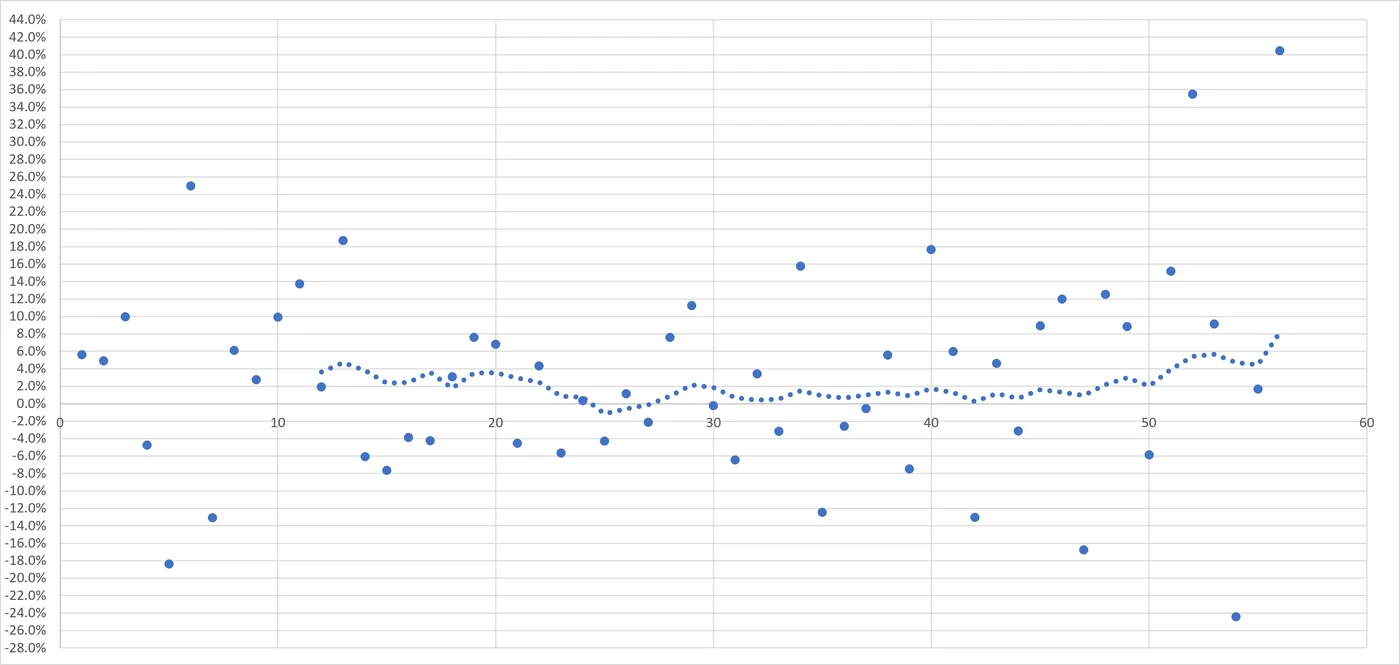
Monthly relative performance vs BTC, 57-month scatter

Monthly relative performance vs BTC · 57 months
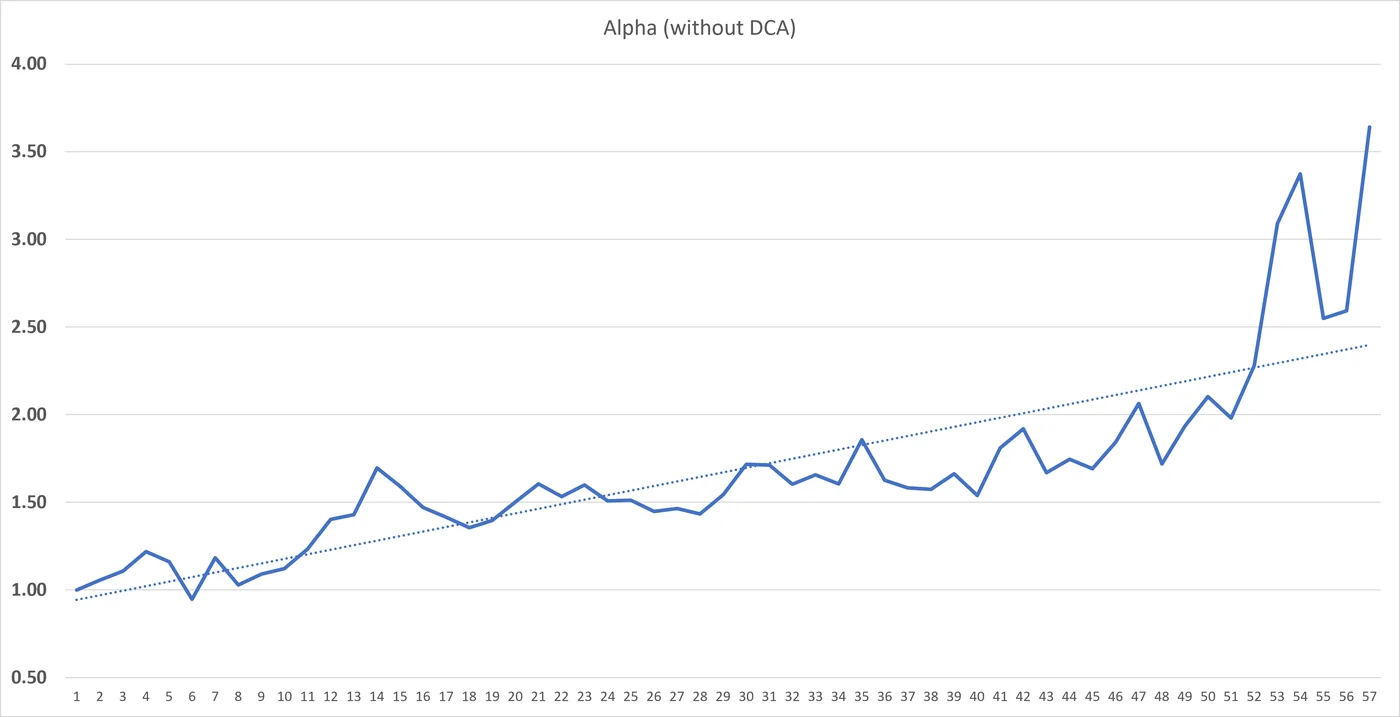
Cumulative alpha curve over 57 months

Cumulative alpha vs BTC · 57 months

None of this guarantees the next cycle. The rule sets are explicit, the vault code is published on-chain, and I only get paid on profits you actually realise.

The One-Trade Guarantee


Seven days. If you can't point at one call that paid for the year, you don't pay.

Join Premium today. Spend 7 days inside Autopilot: read the strategy reports, watch the live dashboards, ask anything in the Telegram support channels. You do not have to deposit a cent to do any of that.

If you don't think the membership is worth 10× what you paid, email me at gerhard@the-bitcoin-strategy.com and I'll refund every cent, no forms, no friction.

Straight answers before you deposit


Access and membership

Yes, to deposit. Autopilot is a members-only product of The Bitcoin Strategy, and the right to deposit is tied to an active Premium membership. Withdrawing is not: that right lives in the contract and does not depend on your subscription. You can also look around the whole platform during your 7 days without depositing anything.

Nothing happens to it. Your shares stay in your wallet, they keep tracking the strategy, and you can withdraw at any time, exactly as before. The only thing that stops is your ability to make new deposits. If you cancel while invested you keep full access to the withdrawal flow, and you can renew to start depositing again.

Any self-custody wallet you control. MetaMask and Rabby are the common choices, and we recommend backing yours with a hardware wallet. There is no "pay by card" route into a vault: this is on-chain, so you need a wallet and you are responsible for its keys. On a phone, open Autopilot inside your wallet's own built-in browser rather than connecting from a normal mobile browser.

Technically tiny, practically not. $5 is the technical minimum the bridge will carry; in practice the fixed network costs only make sense from a few hundred dollars up. There is no minimum imposed by us, and no maximum other than the vault's deposit cap.
Getting money in and out

Through the deposit rail in the app. You hold native USDC in your Arbitrum wallet; the app walks it from Arbitrum to Hyperliquid and into the vault, one signed step at a time, showing you the balance at each stage. Nothing is custodied by us at any point in that chain. If your funds are already on Hyperliquid, you skip the first step.

You ask, the contract pays. Small withdrawals are paid instantly from the vault's liquid buffer. Larger ones are queued and settle once positions have been reduced, typically within about 15 minutes. In stressed or illiquid markets it takes as long as it takes to close positions at fair prices, and for the vaults that trade stock or oil markets a weekend queue can run longer because the underlying markets are shut. There are no lock-ups and no notice periods.

You do, through the contract. Deposits go into a smart contract on Hyperliquid's HyperEVM, and your claim on it is an ERC-4626 share token sitting in your own wallet. We never take custody. The contract has no function that sends vault assets anywhere except back to depositors, and the trading key can place orders and nothing else: it cannot withdraw. The source is verified and published, so you can read exactly what it can and cannot do before you deposit.

You keep your right to withdraw. We may pause deposits, pause trading, or wind a vault down, for example if a strategy stops working or a market we depend on changes. In every one of those cases members keep the right to take their share out. A pause stops new money and new trades; it does not touch your claim on the assets.
Fees

2% a year plus 10% of your own profit. The management fee accrues continuously against the assets in the vault and is already inside the share price you see, so there is no separate bill. The performance fee is charged only when you withdraw, and only on the gain your own shares made against what you personally deposited. Deposit $10,000, withdraw $12,000, and you pay 10% of the $2,000 gain, which is $200. Withdraw at a loss and you pay no performance fee at all. There is no deposit fee and no exit fee.

No. Fees are enforced by the vault contract, and for a deployed vault they can only ever be lowered, never raised. That is a property of the code, not a policy we could quietly change. A future vault could launch with different terms, but they would be published on its own page before anyone deposits.

That one is yours. You are responsible for your own tax reporting and for complying with the laws of your jurisdiction. Nothing here is tax advice. Your deposits, withdrawals and share balances are all on-chain, so the record you need is public and permanent, and the member dashboard shows your own history.
Risk and expectations

Yes to the first. No to the second. These vaults trade leveraged perpetual futures and losses are real and can be rapid. Your shares can be worth a lot less than you put in. What you cannot do is owe money: your exposure is capped at the value of the shares you hold, and there is no way for a vault loss to reach back into your wallet. Deposit only what you can afford to lose.

Because capacity is real and finite. Every strategy is limited by how much size the order books it trades can absorb before its own orders start moving the price against it. Past that point extra capital makes returns worse for everybody already in. So each vault has a cap, and when it fills, deposits close until members withdraw or the strategy can genuinely carry more. It is a limit that protects the members already inside, which is why we would rather turn money away than raise it carelessly.

It depends on the vault, and it is longer than you think. The market-neutral vaults aim to grind out returns over months, so judge them over quarters, not weeks. The leveraged trend vault is a multi-year bet with drawdowns as deep as Bitcoin's own, and it will spend long stretches looking wrong. If you expect a smooth line upward every month, none of these are the right tool. You can still withdraw whenever you want; the point is that leaving at the first drawdown is how systematic strategies get turned into losses.
The contract has not been independently audited. It was written for this product, tested end to end, and is operated with the owner's own capital alongside members'. An external audit is planned. We would rather you knew that before you deposited than after, so weigh it properly: a bug in a smart contract can mean partial or total loss.
Risk notice. These vaults trade leveraged perpetual futures. Losses are real and can be rapid, and a strategy that worked in one market period can stop working quickly and permanently. Every backtest on this page is a backtest, not a forecast. Each position leg is margined separately, and a large enough adverse move liquidates that leg; the strategies exit losers long before that point, but a price that gaps straight through a stop is filled wherever the market is. Smart contracts can contain bugs. Autopilot depends on Hyperliquid, its chain and its liquidity, so an outage, a delisting or a change on their side affects the vaults directly. Automated trading can fail in ways manual trading does not. Deposits are denominated in USDC and carry stablecoin risk. You use Autopilot at your own risk and you alone bear any loss. Nothing on this page is investment, legal or tax advice, and nobody involved in Autopilot manages money on your behalf. The full terms are on the risks page inside the member area.

Ready to put it on autopilot?

A Bitcoin Strategy membership gives you deposit access to every vault, the live dashboards, the strategy reports, Telegram support, and weekly objective analysis of the market they trade in.

100% money-back inside 7 days  ·  Withdraw from a vault any time  ·  Read member reviews of The Bitcoin Strategy  ·  Already a member? Open Autopilot

Start My 7-Day Risk-Free Access